Resist Dyeing with Chickpea Paste (Takarajima Senkou)
0:46

Features
- Strength: Resist dyeing using a natural material (low environmental impact)
- Strength: Dual function as viscosity control and resist agent
- Strength: Expression through irregularity and bleeding
- Strength: Layered expression through combination with other dyes
- Challenge: Difficulty in achieving reproducibility
- Challenge: Manual process with inherent instability
Initiative Details
- Resist dyeing using a natural material
- By using chickpeas—an edible, natural ingredient—it offers a low environmental impact and a sustainable, biodegradable technique.
- Functional as a paste medium
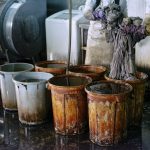
- The ground chickpea paste not only acts as a resist but also helps control the retention and spread of dye.
- Expression through chance and variation
- Application and kneading create irregularities such as bleeding and unevenness, resulting in organic, one-of-a-kind patterns.
- Compatibility with multiple materials and techniques
- Can be combined with indigo, plant-based dyes, or ink to produce layered and complex visual effects.
- Freedom of hand-driven design
- Allows intuitive, hand-based application with brushes or hands, enabling expressive designs unconstrained by fixed patterns.
Commentary
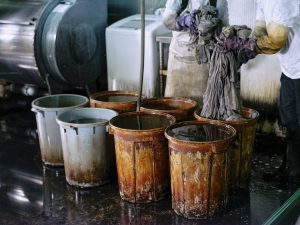
Takarajima Senkou is a dyeing studio that works primarily with natural dyes, experimenting with and pursuing contemporary, original expressions by extracting and combining traditional dyeing techniques from Japan and around the world.
In creating patterns, they employ a wide range of methods—from seemingly simple, hand-based resist techniques such as folding, pleating, and pinching, to more complex traditional processes like clamp dyeing, shibori, printing, spraying, and paste resist—often combining multiple techniques.
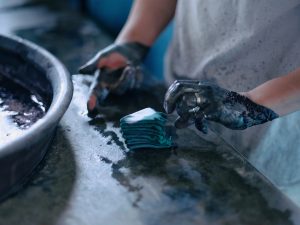
Dyeing may seem like something specialized and distant, but when observing the work of founder Chiharu Ogomori, it feels more like an everyday act—akin to playing with one’s hands or cooking—something naturally embedded in daily life.
One example is the use of chickpeas. Chickpea flour (besan) is commonly used in Indian textile techniques as a binder to help pigments adhere and as a thickening agent in printing. In particular, in Indian block printing, it is mixed with iron scraps and sugars, then fermented to create a black pigment paste.
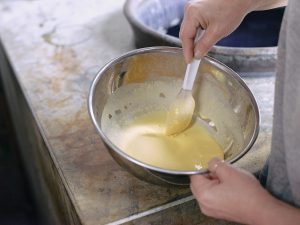
While exploring printing and stencil-dyeing techniques, Takarajima Senkou had also used traditional Japanese starch pastes, but these were difficult to control in viscosity and required large amounts of water. It was a staff member who discovered and proposed the use of chickpeas. Simply mixed with water, they are easy to use and, being a stable material, also well-suited from a sustainability perspective.
Boiled and turned into a paste, chickpeas are scattered randomly onto fabric as a resist, creating irregular textures. Ink dye is then sprayed over the surface, revealing natural, unintentional patterns. The scene feels less like a dyeing workshop and more like a kitchen, where something is being created intuitively and spontaneously.
They have also experimented with techniques that mix chickpea paste with dyes such as ink or logwood, applying or spraying the mixture directly onto the fabric.

Another strength of Takarajima Senkou lies in not leaving such experimentation as purely individual or artistic expression. Ogomori translates these discoveries into rationalized processes, documenting them so that any staff member can reproduce the results. They calculate the time and labor required, and test whether the process can be scaled into products suitable for medium-scale production.
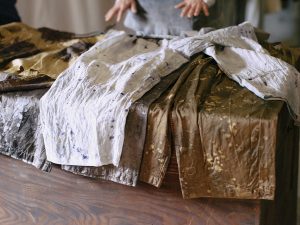
Underlying this approach is a desire to make the act of dyeing—something humans have long practiced using natural and everyday materials—accessible to more people. Rather than remaining a niche or luxury craft, it is opened up as a form of knowledge and practice that was once an ordinary part of life.
A Form of Resist Dyeing in Dialogue with Nature
Through resist dyeing using chickpeas as a natural material, we explore ways of dyeing that engage directly with materials and the environment. Rather than seeking only uniform and controlled results, we embrace accidental expressions—such as bleeding and irregularity—as rich values born from a dialogue with nature. By accepting the inherent uncertainty of handcraft, we draw out its unique appeal and bring it into contemporary life as a new form of expression.