Precision Warping (Kubo Kasuri Orimono)
0:40



Features
- Strength: A high-precision warping process that defines the pattern
- Strength: Stable pattern reproduction through uniform tension and alignment
- Strength: Supporting the refined beauty of warp kasuri
- Strength: Pursuit of precision through time-intensive handwork
- Challenge: Highly time- and labor-intensive process
- Challenge: Sensitivity to even slight misalignment
Initiative Details
- A foundational process that determines pattern precision
- By arranging the warp threads in the correct order and placement, it plays a crucial role in defining the final quality of the kasuri pattern.
- Stability through tension control
- Maintaining even tension in the threads minimizes distortion and misalignment in the finished fabric.
- Realization of refined warp kasuri expression
- Enables precise construction of warp-based patterns, resulting in sharp and well-ordered designs.
- High-precision adjustment through handwork
- Careful, thread-by-thread handling ensures a consistent and finely controlled outcome.
- A key process influencing downstream quality
- The accuracy of aramaki directly affects the stability and quality of subsequent weaving processes.
Commentary
The foundation of pattern-making in Kurume kasuri lies in tying the yarn. Yet within each stage of the process, there is hidden potential to introduce variation and movement into the pattern. Kubo Kasuri Orimono is a workshop that focuses specifically on warp kasuri—where only the warp threads are resist-dyed—pushing the boundaries of expression within this technique.
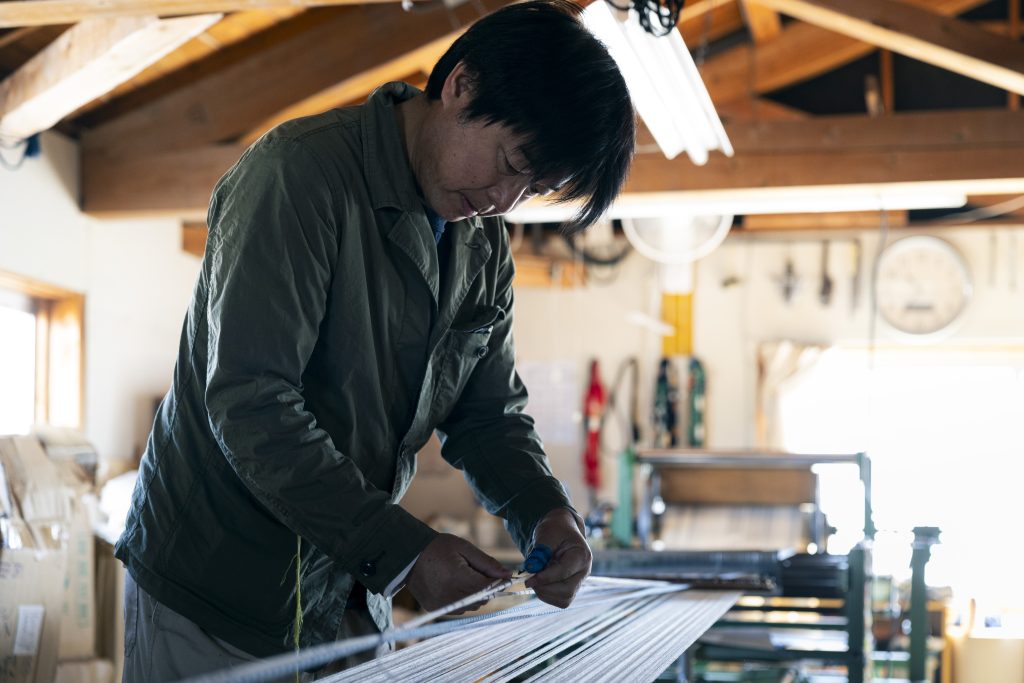
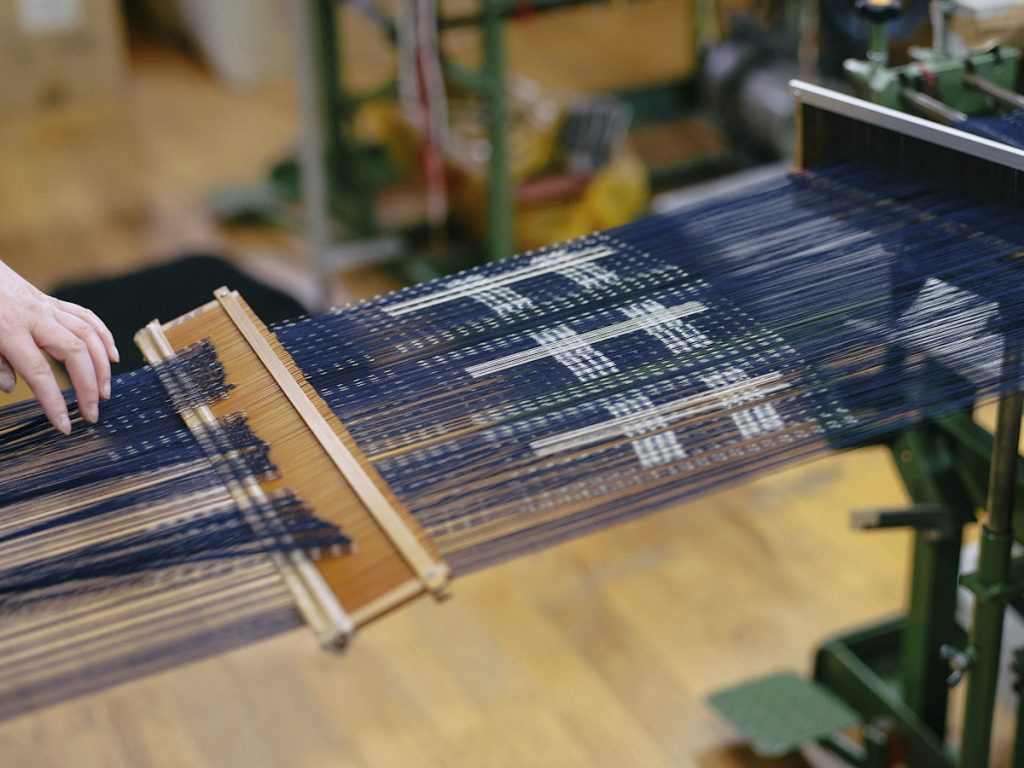
One of the first things that stands out when visiting their workshop is the importance placed on the process known as aramaki (warping). To weave a standard bolt of Kurume kasuri (approximately 36 cm in width), between 800 and 1,200 warp threads are required. The aramaki process involves threading each of these warp yarns through the reed, arranging them in order, and winding them onto the beam that is attached to the loom.
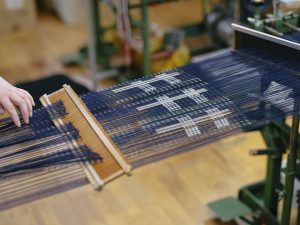
In warp kasuri, where patterned yarns are used for the warp, this arrangement process becomes extremely complex. Bundles of pre-tied yarn must be divided into the required quantities and carefully combined with plain yarns in precise sequence. Unlike weft kasuri, however, the resulting pattern can already be visualized at this stage, making it not only demanding but also visually engaging.
At Kubo Kasuri Orimono, there are three aramaki machines—where most workshops typically have only one. Here, one can see the frequent creation of highly intricate warp kasuri patterns, as well as the use of a technique called gunoma, in which warp threads are pulled up and down during the warping process to shift the pattern and create variation. Gunoma has long been used to produce the iconic yagasuri (arrow patterns), and at Kubo Kasuri Orimono, it has been further developed into more complex, evolved designs.

To achieve such richly detailed warp kasuri, the workshop takes exceptional care in the aramaki process. While most workshops complete one bolt (approximately 12 meters) in a single day, Kubo Kasuri Orimono may spend two to three days, prioritizing precision above speed. In addition, even during the weaving stage, they may adjust the loom to shift the warp threads vertically, further altering the pattern. This deep focus on warp threads has earned them a reputation within the Kurume kasuri industry as “Kubo, the master of warp kasuri,” known for the fineness and beauty of their designs.

This pursuit of detail may also be influenced by the background of third-generation head Ryuji Kubo, who is also a licensed architect. The workshop actively engages in new challenges, such as developing fabrics using chenille cotton yarn for the weft, or creating “Y-style denim,” a kasuri denim fabric with innovative random gradient patterns made using warp threads dyed through the chusen technique by the Chikugo Sensyoku, a regional dyeing cooperative association.
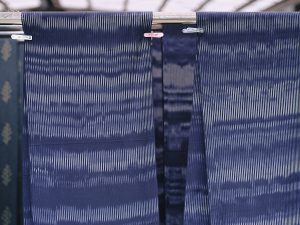
Unlike weft kasuri, which allows for curves and pictorial designs, warp kasuri tends to be more constrained, with patterns easily becoming repetitive due to the nature of tying. Yet Kubo has chosen to delve deeply into this challenging domain, fully exploring its structural possibilities and continuing to create new and unexpected expressions.
The Precision of Kasuri Hidden in Invisible Processes
We value not only the beauty of the finished fabric, but above all the precision of the processes that underpin it. We believe that the essence of pattern accuracy and fabric quality lies in the often unseen step of aramaki. By carefully engaging with each individual thread—meticulously adjusting tension and alignment—we create kasuri with minimal irregularity and refined beauty. Precisely because this process is not visible on the surface, we approach it without compromise, sustaining the quality of Kurume kasuri and carrying it forward to the next generation.