Connecting Textiles and Furniture (Takayama)
0:44




Features
- Strength: Fusion of material (textiles) and structure (furniture)
- Strength: Value creation through collaboration between workshops
- Strength: Reframing textiles as everyday tools
- Strength: Balancing usability and individuality through craft-based production
Initiative Details
- Fusion of material and structure
- Combines the softness of textiles with the structural qualities of furniture to create new types of products.
- Expansion of use (from clothing to living spaces)
- Extends textiles from apparel into furniture and interiors, transforming them into elements that enrich everyday life.
- New value through cross-disciplinary collaboration
- The intersection of weaving and woodworking enables expressions and functions that cannot be achieved independently.
- Balance between craftsmanship and scalability
- Merges industrial precision with the nuance of handwork, resulting in products that are both practical and distinctive.
- Reframing design for everyday living
- Reinterprets textiles as furniture that people interact with daily, creating lasting value rooted in everyday use.
Commentary
The Chikugo region in southern Fukuoka is a dense cluster of everyday crafts. Woodworking (furniture, Buddhist altars, tubs, cutting boards, toys), bamboo craft, washi paper, lanterns, ceramics, textiles, metalwork—many forms of craft related to daily life still remain, albeit on a small scale. Tracing the reason for this concentration ultimately leads to the Chikugo River.
As the largest river in Kyushu, the Chikugo River originates from Mount Aso, flows through Hita—a historic water town—and runs across the Chikugo region before reaching the Ariake Sea. Beyond serving as a vital water source for production, it also functioned as a major transportation artery. Logs from Hita were floated downstream on rafts to Okawa, a practice known as ikada-nagashi. The furniture industry in Okawa City is said to have developed on the back of this river-based logistics network.
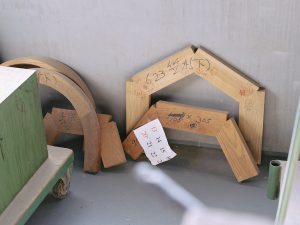
Located in Yame District, Fukuoka, Takayama began as a woodworking business in this craft-rich region, producing children’s toys and baby beds. Over time, it shifted toward furniture-making in response to changing demands, and today specializes in semi-order furniture crafted from solid wood.
Around 2013, through the Fukuoka Prefecture-led “Chikugo Genki Project,” the company encountered designer Gaku Takasu. Recognizing Takayama’s hybrid production style—combining machinery and handcraft—they launched a new in-house brand called “manuf,” derived from “manufacture.”
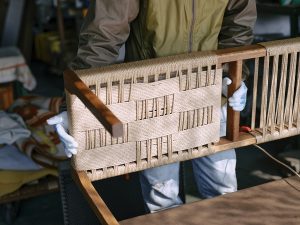
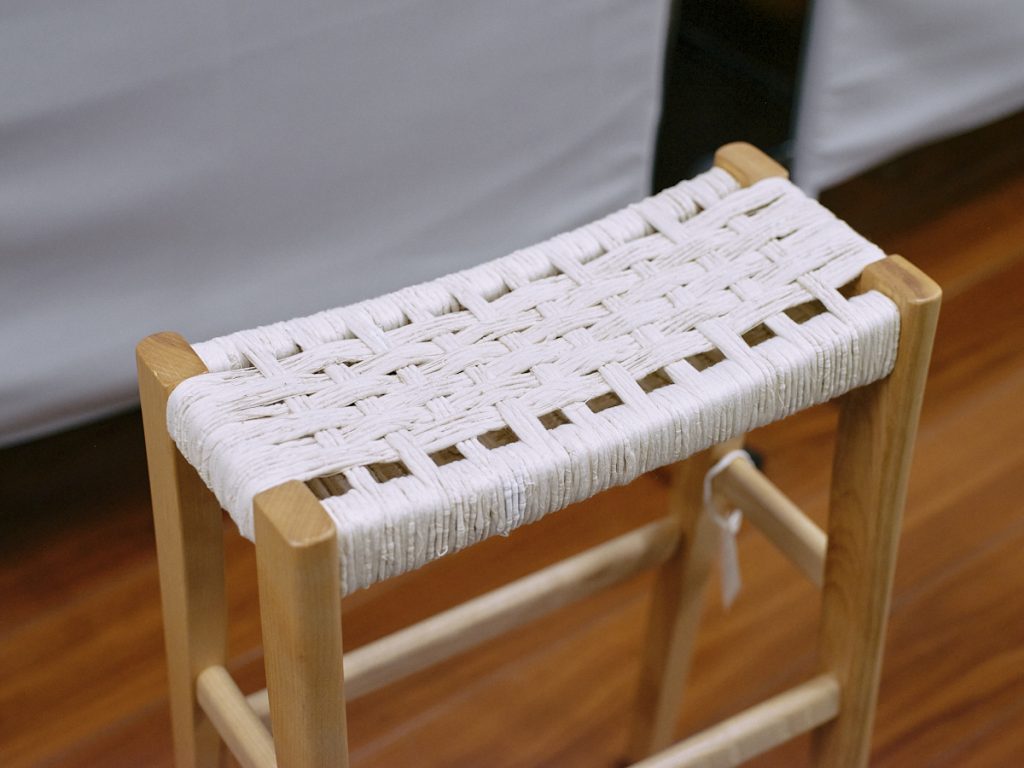
The woven-seat stool made with paper cord emerged as a signature expression of Takayama’s identity as a form of factory-based craft. Without the use of machines, the weaving is done entirely by hand by a two-person team, taking anywhere from half a day to a full day to complete a single seat. While experiments were conducted with materials such as igusa and kasuri yarn, issues of strength and flexibility made them difficult to control; for now, paper cord has proven to be the most suitable material.

The presence of woven seats has also opened up possibilities beyond woodworking, creating opportunities for collaboration with other fields. In the I/KAT project—a regional initiative for Kurume kasuri led by creative director Shohei Iida—Takayama explored the affinity between woven seats and textiles, contributing to the creation of stools using paper cord dyed in a kasuri-like manner.

Furniture typically favors hardwood, and most materials today are imported from North America and Europe. However, Takayama has also been exploring the use of domestic wood. For the past decade, they have used Japanese chinaberry (sendan) and chestnut wood for chair legs. Chestnut, in particular, is suitable for dyeing: when treated with persimmon tannin and then an iron mordant solution, it develops a deep black color.
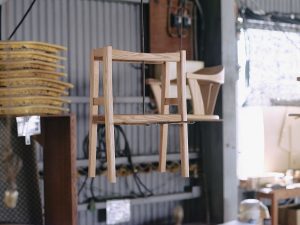
Craft is shaped by the combination of materials and techniques. Historically, the Chikugo region sustained a rich ecosystem in which various makers and industries overlapped and occasionally collaborated. In today’s era—when handcraft has significantly declined—this way of working may once again hold essential value.
Where Textile Meets Wood: New Touchpoints for Everyday Living
By connecting the distinct realms of textiles and furniture, we aim to create new value within everyday life. Combining the softness and expressive qualities of fabric with the structure and durability of woodworking, we realize comfort and beauty that have not existed before. Embracing the possibilities that emerge when different materials and techniques intersect, we strive to craft products rooted in daily life—objects that are made to be used and cherished over time.