

Shimogawa Orimono
A Kurume kasuri weaving company founded in 1948 in Yame City, Fukuoka Prefecture
Videos & Posts
3
-

Weaving original fabric designed by textile designer Hana Mitsui
Our tagline is: “A weaving studio that supports those who enjoy life alongside kasuri.”
By continuously taking on the challenge of preserving and innovating traditional craftsmanship, we express the joy and beauty of making things through Kurume kasuri.
Features
- Strength: Extensive experience collaborating with creators both in Japan and abroad.
- Strength: Experimental craftsmanship grounded in solid technical expertise.
- Strength: Beyond cotton, we actively explore the use of other materials such as wool and silk.
- Strength: Capable of producing a wide range of weave structures, including twill and seersucker.
- Strength: Large inventory of deadstock fabrics.
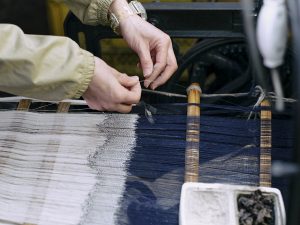
- Strength: Power-loom weaving using indigo-dyed yarns.
- Challenge: English communication requires an intermediary.
- Challenge: Depending on the situation, new orders may require additional lead time.
Our Abilities
Based on the use of narrow-width power looms, the following capabilities are available.
- Pattern expression in Kurume kasuri based on traditional tie-resist (“kukuri”) techniques.
- Custom and made-to-order production available.
- A medium-scale production system using machine-based tying (kukuri) and power looms.
- Creative ideas and techniques for rich color expression by combining indigo dyeing with chemical dyes.
- Focusing on cotton, while exploring combinations with other materials such as wool and silk.
- Focusing on plain weave while exploring variations such as twill and double-beam weaving structures.
Reimagining Kurume Kasuri: A Fabric of Thought
We value leaving “space” (yohaku), respecting the interpretations and creativity of both those who teach and those who learn. We also actively employ local mothers as craftspeople and have been restructuring our organization to enable a gradual generational transition, led by three generations of management alongside a broadly distributed age group.
Furthermore, through Kurume kasuri, we translate history and culture by weaving together diverse axes—across countries and disciplines—and reinterpret them into new expressions produced as kasuri, updating the craft for the present day. Based on this approach, we collaborate with artists and designers both in Japan and abroad, continuously reinterpreting and presenting Kasuri as a “fabric of thought.”
