Tsumami-Dyeing (Marugame Kasuri Orimono)
0:39



Features
- Strength: A post-dyeing technique that adds color selectively
- Strength: High precision through handwork
- Strength: Capability for multi-color and complex patterns
- Strength: A rare technique unique to Kurume kasuri
- Challenge: Highly time- and labor-intensive
- Challenge: Requires advanced skill and concentration
Initiative Details
- Accent expression through partial dyeing
- By applying dye to specific areas of the yarn, it enables point-based color accents and subtle nuances that are difficult to achieve with conventional kasuri.
- High precision through handwork
- Artisans apply dye one point at a time, allowing for accurate placement and delicate design control.
- Multi-color and complex compositions
- The use of multiple dyes creates layered, three-dimensional patterns and highly expressive, fashion-oriented designs.
- Expansion of kasuri’s expressive range
- Complements resist-dyeing techniques such as kukuri, enabling expressions beyond traditional kasuri limitations.
- A rare, region-specific technique
- Preserved by only a limited number of workshops, it represents a distinctive characteristic of Kurume kasuri.
Commentary
Marugame Kasuri Orimono carries out all processes in-house—not only fabric production, but also apparel planning, sewing, processing, and sales. This integrated approach allows the company to create textiles with bold patterns and vivid colors suited for fashion items such as clothing and bags. One of the key techniques supporting this expressive capability is tsumami-dyeing.
Kasuri patterns are created through a technique called kukuri, in which bundles of yarn are bound to resist dye and then woven to form patterns on the cloth. However, when multiple colors are involved, the tying and dyeing processes must be repeated many times. Because of this complexity, kasuri is not well suited for adding small, point-based color accents.

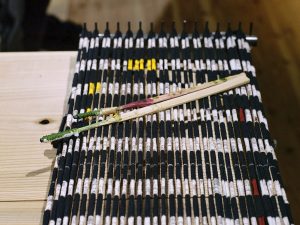
To address this limitation, the technique of tsumami-dyeing has been developed. In this process, a brush made by wrapping cloth around the tip of chopsticks is used to rub dye into the resist-bound sections of yarn bundles.
Before being wound onto the shuttle, bundles of 200 weft threads are aligned and set on a jig with their edges (the turning points of the weft) matched. This makes the areas where color should be applied clearly visible. Using two brushes from above and below, the yarn bundle is gently lifted and rolled, allowing the dye to seep in and add new color to the threads.
A single pattern created in this way corresponds to 24 cm of woven fabric. Repeating this across 200 weft threads results in approximately 48 meters (four bolts) of fabric. Since the jig shown in the photo contains two patterns vertically, the total length doubles to 96 meters (eight bolts).

Although simple in principle, tsumami-dyeing is a labor-intensive process. In the past, Kurume kasuri production was finely divided, and such tasks were outsourced as home-based work. However, as production in the region has declined and fewer artisans remain, there are fewer people to take on this work.
The compensation for this process, a remnant of those times, remains minimal. Marugame Kasuri once accepted tsumami-dyeing work from other workshops, but now carries it out only for its own production. While it is not viable as a business on its own, the company continues to preserve and develop the technique as a means of unique expression.
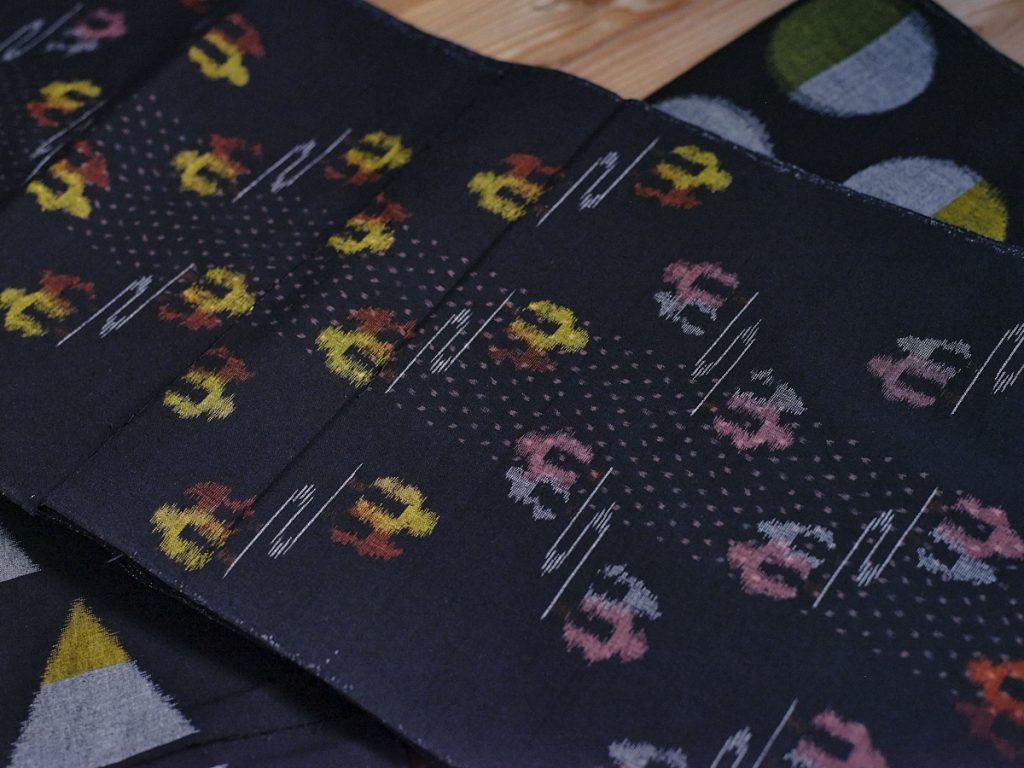
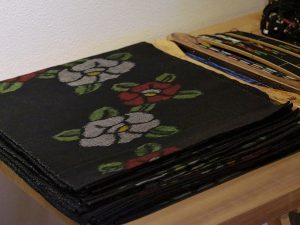
A representative design created through tsumami-dyeing is the tsubaki (camellia) pattern, which expresses red petals. The contrast between red and white flowers and vivid green leaves creates a dynamic yet distinctly Japanese aesthetic. In a tradition dominated by geometric and rhythmic patterns, this design stands out as something truly unique.
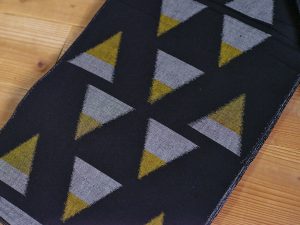
Marugame Kasuri Orimono is also exploring nuanced expressions by applying tsumami-dyeing selectively. In one pattern featuring upward and downward triangles, yellow accents are partially added—placed toward the top for upward triangles and toward the bottom for downward ones.
In another design with large dots on a dark indigo ground, pale blue is irregularly introduced within each circle. The result evokes clouds drifting across the moon, adding movement and depth to an otherwise regular pattern.
Traditionally, tsumami-dyeing was used to fill gaps with additional colors. However, by treating it more like drawing—intentionally leaving areas “untouched”—the technique has evolved into a way to expand the expressive freedom of kasuri. The structured kasuri pattern becomes a canvas, onto which traces of handwork are layered. Through such experimentation, Marugame Kasuri Orimono continues to push beyond conventional boundaries and explore new possibilities in pattern-making.

Expanding Tradition: The Challenge of Tsumami-Dyeing
While carefully preserving the traditional techniques of Kurume kasuri, we are committed to expanding its expression for the present day. Tsumami-dyeing is a technique that introduces colors and nuances not achievable through conventional kukuri methods alone, opening up new possibilities for kasuri. By applying dye by hand, piece by piece, we pursue delicate and rich expressions, creating textiles that resonate with fashion and contemporary lifestyles. Rooted in tradition yet driven by free and innovative thinking, we continue to shape the future of kasuri.