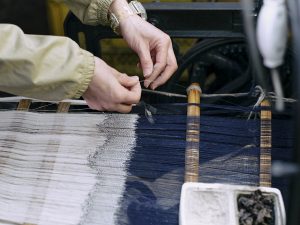
Collaboration with textile designer Hana Mitsui (Shimogawa Orimono)
0:31



Features
- Strength: Creation of new kasuri expressions through cross-disciplinary sensibilities
- Strength: Design that embraces “misalignment” and “fluctuation” as value
- Strength: Use and reconstruction of sustainable materials
- Strength: Expansion into an international context
- Challenge: Frequent trial and error due to technical constraints
- Challenge: Difficulty in reproducibility and scalability
Initiative Details
- New expressions through the fusion of different sensibilities
- The intersection of traditional Kurume kasuri and international textile design creates a new aesthetic language.
- A design philosophy that embraces “fluctuation”
- Treats kasuri’s inherent misalignment and chance not as flaws, but as values to be intentionally incorporated.
- Sustainable material development using surplus textiles
- Reconstructs leftover fabrics into yarn, forming a circular approach to creating new textiles.
- Introduction of visual experimentation such as optical effects
- Combines kasuri structures with visual illusions to generate previously unseen visual experiences.
- Global presentation and application
- Showcased on international platforms such as the Milan Salone, expanding into apparel and everyday products.
Commentary
For Kyozo Shimogawa, the third-generation head of Shimogawa Orimono, Kurume kasuri is a tool for communication. The structure created by the interweaving of warp and weft threads is surprisingly versatile and full of possibilities. That is precisely why he believes it is important to create together with people who bring perspectives and sensibilities different from his own.
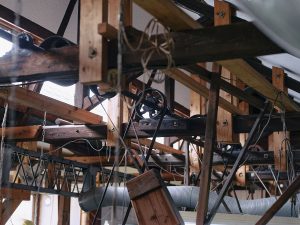
For Shimogawa Orimono, the collaboration with textile designer Hana Mitsui has been a project that truly expanded the possibilities of Kurume kasuri.
Mitsui, who has worked as a textile designer for internationally renowned brands such as Issay Miyake, now runs her own textile practice, HANA LAB. Since her time at the Royal College of Art in the UK, she has been interested in traditional Japanese techniques such as sakiori (rag weaving) and kasuri. She has also developed projects that transform surplus inventory and discarded fabrics from the fashion industry by cutting them into strips and reweaving them as weft yarns.
Through this shared interest, Mitsui encountered Shimogawa Orimono. Their exchange began around 2021, and early experiments involved weaving yarn made from cut-up surplus printed fabrics on Kurume kasuri shuttle looms. However, the process proved difficult, with issues such as yarn breaking during the winding of weft onto the shuttle.

Amid this trial and error, they turned their attention to a defining characteristic of Kurume kasuri: even with great effort to align patterns, slight misalignments inevitably occur. Rather than resisting this, they embraced it, developing designs that intentionally incorporate “fluctuation.” This led to the 2022 release of the collaboration project “Hana no Yuragi” with Unagi no Nedoko, producing three types of textiles: warp kasuri, weft kasuri, and double ikat.
Building on this, Mitsui’s HANA LAB developed “Optical Illusions Ikat,” a project that explores the relationship between the accidental misalignment created by kasuri binding and visual optical effects. In 2024, the work was selected for SaloneSatellite—often considered a gateway for emerging designers—and exhibited at the Milano Salone. These textiles have since been developed into everyday products such as apparel, bags, and cushions, expanding the ways in which kasuri can be used.
Shimogawa Orimono has also actively welcomed artists, designers, and emerging talents (including student interns) from Japan and abroad as residents, fostering exchange. Participants have come from more than ten countries, mainly in Europe, and some collaborations have led to actual fabric production and orders.
While these activities do not always generate immediate financial returns, for Shimogawa they are about building relationships that may become future business partnerships—and above all, a source of joy. He describes the process as discovering the “core of consistent creativity—the soul” within each individual, tuning it to his own frequency, and creating together.
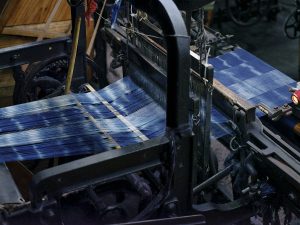
Kurume kasuri is said to have been invented around 1800 by a 13-year-old girl named Den Inoue. Her patterns gained widespread acclaim, and by the age of 40 she had trained around 1,000 disciples. These apprentices eventually spread out and established weaving workshops, forming the foundation of the Kurume kasuri production region. Inspired by her legacy, Shimogawa dreams of cultivating disciples around the world and passing Kurume kasuri on to the next generation.
A New Dialogue in Kasuri Woven from Diverse Sensibilities
We see Kurume kasuri not merely as a traditional craft to preserve, but as a medium for communication that connects people. Through our collaboration with Hana Mitsui, we have expanded the possibilities of kasuri by engaging with perspectives and sensibilities beyond our own. Embracing elements of chance—such as pattern misalignment and differences in materials—we find value in creating new expressions together. Moving forward, we will continue to engage in dialogue with diverse creators from Japan and around the world, carrying Kurume kasuri into the next generation.