Revival Through Fashion (Aimoriyama)
Read time 5 min
-
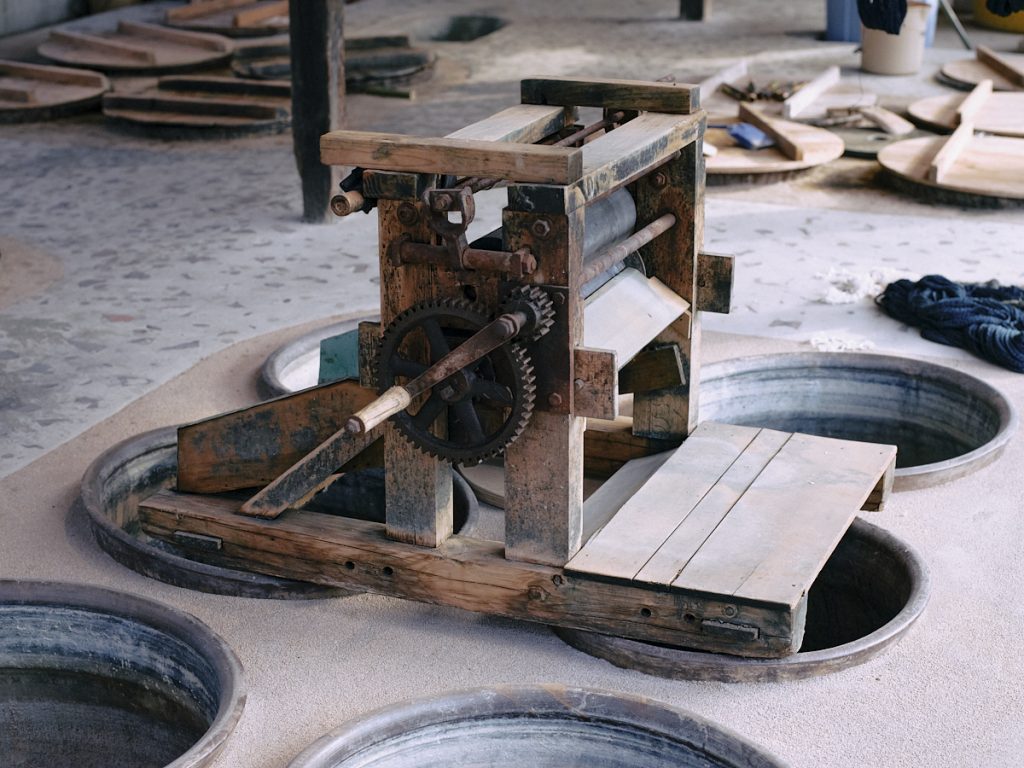
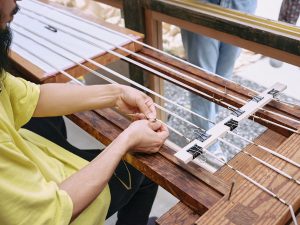
The shimebata (tightening loom) used for Bunjin kasuri is tightened to bind the threads—a traditional technique later inherited by textiles such as Oshima Tsumugi.

Features
- Strength: Redefining traditional value through fashion
- Strength: Market expansion through brand collaborations
- Strength: A means of securing funding and relationships for revitalization
- Strength: A new workshop model integrating experience and storytelling
- Challenge: Challenges in balancing tradition and commercialization
Initiative Details
- Reframing value through fashion
- Reconstructs traditional craft as contemporary clothing, redefining its value as a living, usable culture.
- Ensuring sustainability through market connection
- By bringing products into circulation, it establishes continuous revenue and a stable operational foundation for the workshop.
- Expanding recognition through branding
- By articulating a distinct worldview, it reaches new audiences both domestically and internationally.
- Expanding expression through collaboration
- Collaborations with designers and brands open up new designs and applications beyond traditional uses.
- Integrating communication and experience
- Beyond products, workshop experiences and storytelling help cultivate a community of fans and supporters.
Commentary
For Kurume kasuri weavers—especially those engaged in indigo dyeing—water is their lifeline. Large amounts of water are required for both dyeing and washing, and hard water containing minerals such as iron and calcium can prevent proper color development. For this reason, most workshops still rely on local sources of soft water, such as well water or river water.

Founded in 1858 (Ansei 5), Aimoriyama is the oldest existing Kurume kasuri weaving house. Located in Hirokawa Town, where many workshops remain, it draws its water from the Hirokawa River, as its name suggests, and has continued traditional indigo dyeing using natural lye fermentation for six generations. The workshop also produces Kurume kasuri designated as an Important Intangible Cultural Property of Japan, which requires hand-tying and hand weaving, and is particularly known for its finely detailed small patterns such as kagasuri and jujigasuri.
In June 2023, the workshop suffered devastating damage from the record-breaking Northern Kyushu floods. More than 50 indigo vats were submerged in muddy water along with the dye, with flood levels reaching up to 90 cm above the floor in some areas. Machines for winding yarn were also flooded, and parts of the building were left half-destroyed. It was truly a crisis of survival.
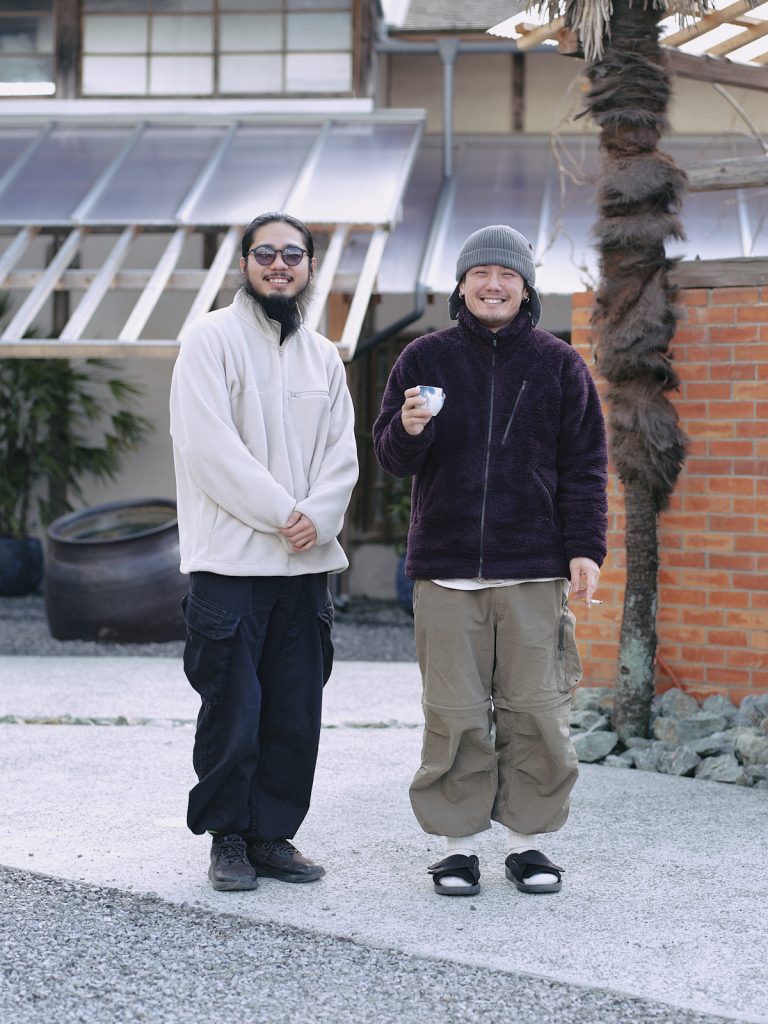
In the face of this disaster, the sixth-generation successors—brothers Koichi Moriyama and Yoshinobu Moriyama—rose to the challenge. Koichi had been involved in fashion and event planning, while Yoshinobu had worked in food and research until their mid-twenties. Drawn back by a shared desire to carry on the family business, they had returned just before the disaster struck.
The road to reconstruction was far from easy. Many supporters came to help remove mud and debris, and neighboring workshops provided dyeing facilities so they could continue preparing for exhibitions scheduled after the disaster. As they struggled to rebuild, the design and interior of the new workshop came to reflect the brothers’ vision and sensibility, unintentionally becoming a space that embodies a future-oriented model for Kurume kasuri.
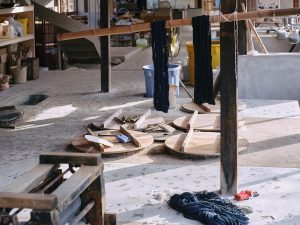
The new workshop was completed in June 2025, exactly two years after the disaster. As much as possible, the beams of the old workshop were preserved, and fragments of indigo vats broken in the flood were embedded into the polished floor of the dyeing area. “This is our root,” the sixth generation says—revealing a stance that is deeply grounded in place while remaining open to new sensibilities.
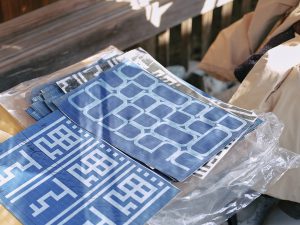
Koichi has a strong interest in fashion history, including street and punk culture, and believes that even traditional kasuri patterns can be reinterpreted through new perspectives and contexts. In addition to collaborations with brands such as 45R and BEAMS, he has begun developing original clothing using kasuri fabrics.
“I want to create a place like a town where food, clothing, and shelter come together.” In response to this vision, his younger brother Yoshinobu—who has a research-oriented mindset—has begun exploring spice curry, presenting it at events. In the future, they aim to create not just a dyeing and weaving workshop, but a space with a shop and food offerings—a kind of third place where people can gather.

To achieve this, their goals are clear: to restore indigo dyeing from scratch after the disaster, and to faithfully inherit the pattern-making techniques—such as tying and weaving—passed down from their grandfather (fourth generation) and father (fifth generation). Perhaps it is precisely these two brothers who can realize a workshop that is at once the most traditional and the most innovative.
Reviving Kasuri Through Fashion
We aim not only to preserve the tradition of Kurume kasuri, but to revive it as something that lives again within contemporary life. By working through the realm of fashion, we deliver the appeal of kasuri in new forms, enabling both the reconstruction of the workshop and the creation of a sustainable model of craftsmanship. While engaging with the market and society, we remain committed to the value of handwork and the beauty of materials, elevating them into expressions that resonate with the present. Moving forward, we will continue to weave the future of Kurume kasuri in ways that stay close to people’s everyday lives.