Tate-Yoko Kasuri and Yatara Weaving (Nomura Orimono)
Read time 5 min
-
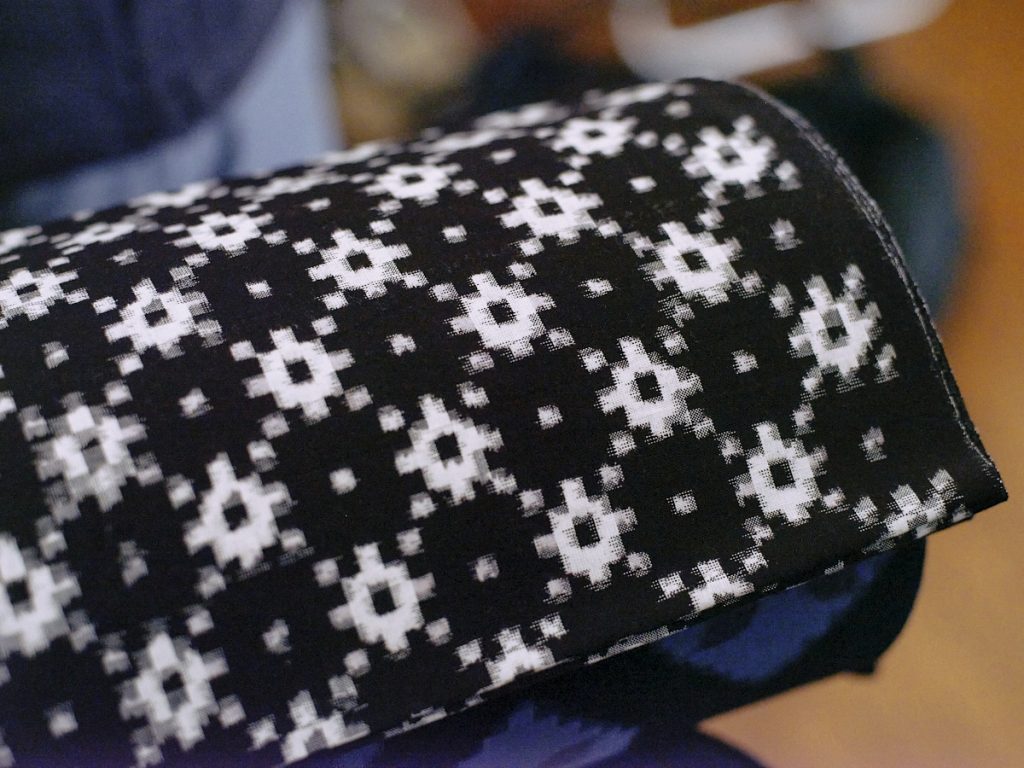
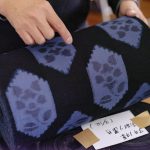
One type of sōgasuri (all-over kasuri), in which both warp and weft threads are resist-dyed to create a continuous pattern without gaps.

Features
- Strength: Highly precise and complex pattern expression through tate-yoko kasuri
- Strength: A unique texture with intentional “misalignment”
- Strength: Rich, organic expression through yatara weaving
- Strength: Flexibility in a wide range of colors and designs
- Challenge: High level of complexity and labor in the process
- Challenge: Difficulty in controlling reproducibility and uniformity
Initiative Details
- Advanced pattern construction through tate-yoko kasuri
- By aligning patterns in both warp and weft, it creates intricate, layered, and highly detailed designs.
- Soft expression through intentional misalignment
- Subtle shifts and blurring—rather than perfect alignment—produce an organic texture unattainable by machines.
- Accidental design through yatara weaving
- Randomly incorporating weft threads results in a unique interplay of regularity and irregularity.
- Creative use of materials and surplus
- Flexible use of leftover threads enables the creation of new patterns and expressions.
- Coexistence of precision and freedom
- The strict structure of tate-yoko kasuri and the free expression of yatara weaving combine to allow diverse design possibilities.
Commentary
Kurume kasuri is a form of ikat in which yarn is bound and dyed before weaving, and then woven after the bindings are removed. As a woven textile, it consists of warp and weft threads. When only either the warp or the weft is resist-dyed, it is referred to in English as single ikat. When both warp and weft are resist-dyed and carefully aligned during weaving—as in tate-yoko kasuri—it is called double ikat, and the level of technical difficulty increases significantly.

With handlooms, each weft thread can be inserted while visually checking the alignment of the pattern, allowing for careful, precise weaving. However, this is not possible with motorized power looms. In such cases, accurate pattern alignment depends on the precision of the preparation process known as nuki-maki (winding the weft onto the shuttle), as well as the sharp eye of the weaver operating the loom.

Nomura Orimono is known as one of the weaving houses capable of producing this highly complex double ikat with remarkable precision on power looms. Following the philosophy of its second-generation owner—“A true weaving house proves itself through the quality of its fabric”—the company has consistently focused on producing high-quality textiles. The centipede-like mechanism attached to their nearly century-old Toyota power looms adjusts the tension of the warp threads to achieve pattern alignment. Because cotton yarn expands and contracts depending on temperature and humidity, its condition changes daily.

Maintaining such strict pattern alignment, however, comes with trade-offs. Even with careful preparation during nuki-maki, variations in yarn elasticity and the nature of hand processes can sometimes lead to significant misalignment. As these “NG shuttles” were set aside, unusable yet too valuable to discard yarn gradually accumulated.
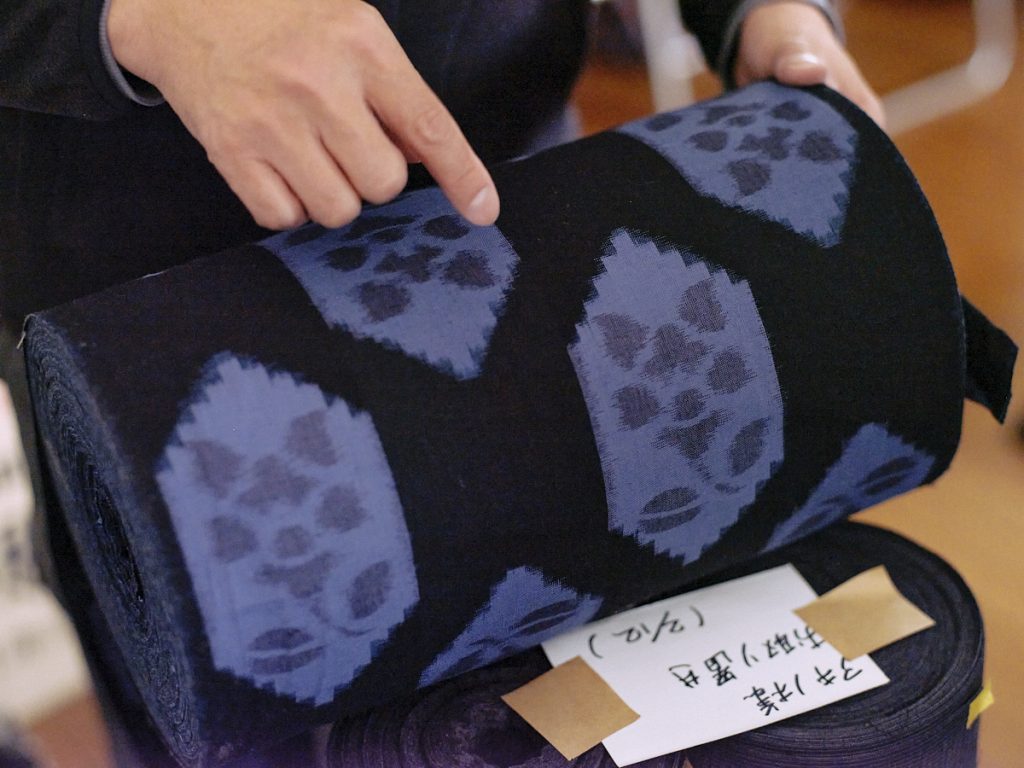
This led to the creation of a fabric known as yatara weaving. By rewinding these rejected threads without re-aligning the patterns, they are transformed into entirely new, random designs. When these weft threads are woven into warp threads arranged in striped patterns, irregular kasuri motifs emerge organically, creating a unique and spontaneous visual effect.

In recent years, as veteran artisans age, Nomura Orimono’s workshop has gradually undergone a generational shift, with younger weavers joining since around the COVID period. While firmly inheriting four generations of kasuri craftsmanship, the workshop continues to evolve by incorporating the flexible thinking and playful spirit of a new generation.
A New Frontier of Kasuri Woven from Precision and Serendipity
While we carefully preserve the traditional technique of creating intricate patterns through tate-yoko kasuri, we also embrace the subtle shifts and variations that arise within the process as a unique charm of kasuri. By incorporating elements of chance, as seen in yatara weaving, we explore new expressions where structure and freedom coexist. Valuing not only precision but also the richness and unpredictability of handcraft, we continue to expand the possibilities of Kurume kasuri.