Machine-Tying (Kurume Kasuri Hirokawa Town Cooperative Association)
0:43






Features
- Strength: Efficient production through machine tying
- Strength: Shared infrastructure supporting the entire production region
- Strength: A system that compensates for the shortage of artisans
- Strength: Coexistence of traditional techniques and mechanization
- Challenge: Limitations in fine, nuanced expression
- Challenge: Reduced flexibility due to machine dependency
Initiative Details
- Stable mass production capability
- Mechanization of the tying process enables efficient handling of large volumes of yarn with consistent quality.
- High reproducibility and precision
- Data-driven operations allow the same patterns to be reproduced reliably and consistently.
- A foundational technology supporting the entire production region
- By handling the tying process for multiple weaving workshops, it plays a crucial role in sustaining Kurume kasuri production.
- A system that compensates for labor shortages
- Offsets the decline of traditional tying artisans, ensuring continuity of both technique and production.
- A balance between tradition and mechanization
- Complements hand-tying techniques while adapting to modern production systems for efficient manufacturing.
Commentary
What fundamentally defines Kurume kasuri is, without question, the process of kukuru—tying. The term “kasuri” refers to a technique in which yarn is bound to create patterns, and is used interchangeably with the English term ikat. The word “ikat” originates from a Malay word meaning “to tie,” and is said to have been spread as a textile term by the Dutch, who once ruled Indonesia, where ikat was widely produced.
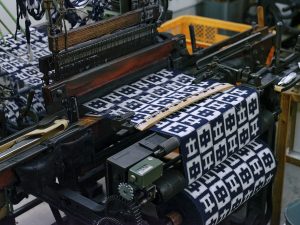
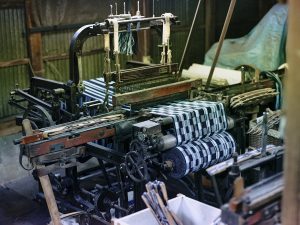
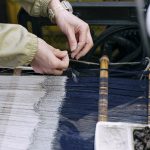
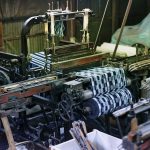
There are two types of this essential tying process: hand tying, in which threads are bound entirely by hand, and machine tying, in which the process is carried out using machines. While most ikat-producing regions around the world rely on hand tying, Japan developed machine tying, enabling medium-scale production of kasuri textiles. Today, Kurume kasuri is the only ikat production region in Japan where this machine-tying system still exists at an industrial scale.
In the Kurume kasuri production area, the tying process has long been divided into specialized labor. In the past, there were many artisans dedicated solely to tying. Similar to the dashibata (distributed weaving) system, tying machines were installed in artisans’ homes or workshops, and they would continuously tie threads brought in by various weaving houses, following specific designs. However, as the scale of production has declined over the years, it has become increasingly difficult for tying alone to sustain a livelihood.
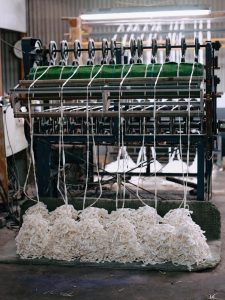
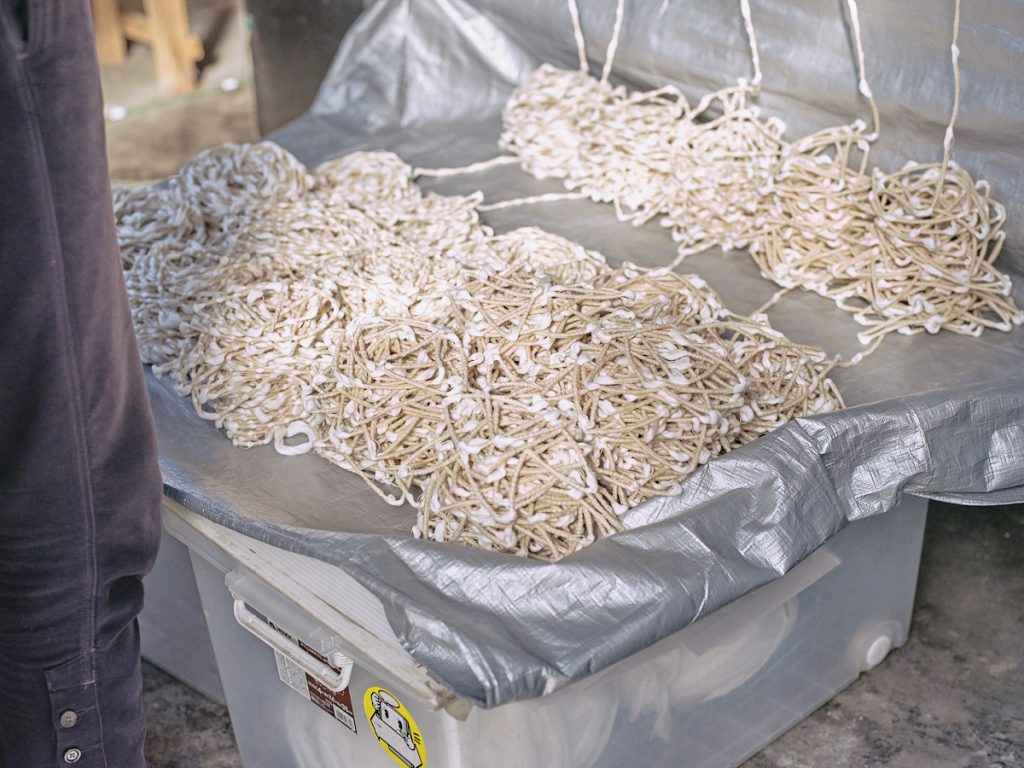
Today, the Kurume Kasuri Hirokawa Town Cooperative Association—jointly operated by local weaving houses—employs tying artisans and carries out both machine tying and the untying process within the cooperative. It functions as the very heart of the Kurume kasuri production region: if the tying stops, Kurume kasuri stops. The two are inseparable.
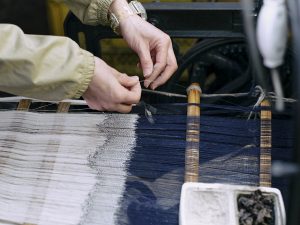
Despite being called “machines,” these tying devices are not fully automated, cutting-edge systems. Like the narrow-width power looms used for weaving Kurume kasuri, they still rely heavily on human hands and eyes to operate. In recent years, technological development in collaboration with universities has introduced some efficiencies—such as scanning designs for automated movement in weft tying—but many aspects still require fine adjustments, including dealing with thread breakage and spacing control.
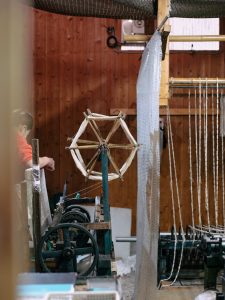
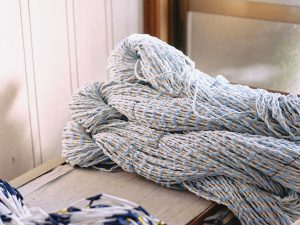
For warp tying as well, the pitch of the bindings must be calculated based on the design provided by the weaving house and manually input into the machine. The cotton threads used for tying are prepared by hand, dipped in a starch paste made from wheat flour, and wound onto bobbins. Any mistake in tying directly affects the final pattern of the fabric, making this a highly responsible and delicate process.
The existence of machine tying has enabled Kurume kasuri to survive into the present day. Except for high-end or designated cultural heritage pieces, hand tying alone would make the fabric too expensive for everyday use in clothing or accessories. The Kurume Kasuri Hirokawa Town Cooperative Association thus plays a crucial role in sustaining the identity of Kurume kasuri—positioned between handcraft and industry.
The Tying Infrastructure that Sustains the Production Region
We see it as our mission to support the entire production region by carrying out the tying process—the essential core of Kurume kasuri. Through machine tying, we ensure stable quality and production volume while providing a foundation that allows each weaving workshop to pursue diverse expressions. Even as the number of artisans declines, we are committed to sustaining both the techniques and processes, passing them on to the next generation. By maintaining a careful balance between tradition and mechanization, we continue to support a sustainable future for the Kurume kasuri production region.