Indigo-Dyed Machine Weaving (Yamamura Kasuri Kobo)
Read time 5 min
-

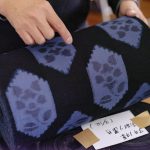
Indigo-dyed yarn is woven using machines—an approach that seeks to balance tradition with scalable production.





Features
- Strength: Stable quality and scalability through machine weaving
- Strength: Reproduction of handwoven-like texture
- Strength: Hybrid use of indigo and diverse dyes
- Strength: Adaptability to a wide range of applications
Initiative Details
- Stable quality and scalable production
- Machine weaving enables consistent quality while producing a steady volume of fabric.
- Reproduction of handwoven-like texture
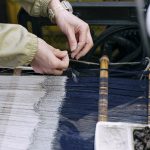
- Through adjustments to the loom and careful handling of yarn, it achieves softness and a natural expression despite being machine-made.
- Depth of color through indigo dyeing
- By using natural indigo and other dyes, it creates rich, layered color variations.
- Adaptability to contemporary applications
- Stable supply allows for a wide range of uses, including apparel and everyday products.
- A balance between efficiency and expression
- A middle-ground approach that maintains industrial productivity while preserving the appeal of traditional kasuri.
Commentary
Kurume kasuri is produced in two main ways: hand weaving and machine weaving. At first glance, one might imagine hand weaving as artisanal and machine weaving as cold and industrial. However, the “machines” used in Kurume kasuri carry a surprising warmth—almost like living beings—making them deeply endearing looms.
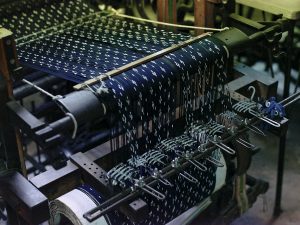
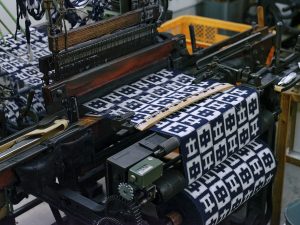
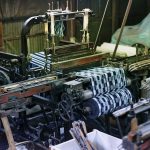
Most of these are narrow-width shuttle power looms made nearly a century ago, formally known as the “Toyota-type iron narrow-width power loom” (commonly called the Y-type loom). This model was developed in 1915 by Sakichi Toyoda, the founder of Toyota. It later spread throughout Japan, particularly in the Tokai region. Introduced to the Kurume kasuri production area in the 1930s, these looms increased productivity by as much as twentyfold, leading to their rapid adoption.
Even today, these looms continue to be used in the Kurume kasuri region. However, Toyota no longer provides maintenance or repair services. As a result, weaving workshops carefully maintain each machine themselves—oiling them daily and, when necessary, sourcing spare parts from looms of workshops that have closed down.
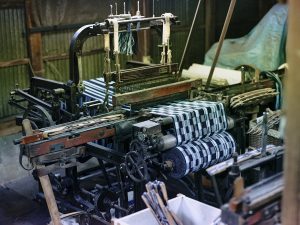
Founded in 1895, Yamamura Kasuri Kobo has weathered the turbulent changes of both Kurume kasuri and Japan’s textile industry. Once a large-scale workshop with 32 indigo vats, it faced a sharp decline in kimono demand after World War II. In 1968, it made a major shift—closing all its indigo vats and transitioning from hand weaving to machine weaving by acquiring power looms from a nearby workshop that had gone out of business. The spread of a new chemical dye known as naphthol dye at the time also supported this decision.
Yoshiteru Yamamura, who took over as the fourth-generation head through marriage, inherited the workshop’s spirit of embracing new technologies rather than relying solely on tradition. He was among the first in the industry to adopt naphthol dyes, designing colorful and pop-inspired kasuri textiles, while also actively developing products such as clothing and accessories.

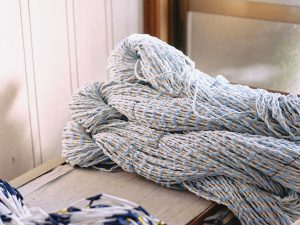
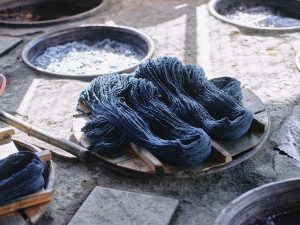
In the 2000s, however, the workshop began to shift back toward indigo dyeing in response to changing times. Yamamura invited Nose, who had trained under a handwoven indigo kasuri workshop, to join him in reviving eight indigo vats. From this effort emerged a new form of fabric: indigo-dyed yarn woven on the traditional power looms—indigo-dyed machine-woven kasuri.
Indigo-dyed Kurume kasuri is inherently time-consuming and costly, making it a luxury product in modern times. Yet indigo remains a core identity of Kurume kasuri, and with the recent renewed appreciation for natural dyes, its popularity has grown. By using machines for the weaving process, indigo kasuri—once out of reach—has become more accessible for everyday use.
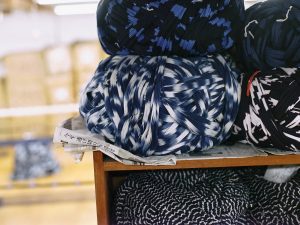
In recent years, the workshop has also focused on fabrics made from gradient-dyed yarns, taking advantage of indigo’s ability to create multiple tones through layered dyeing. They further explore hybrid approaches, combining indigo-dyed yarns with chemically dyed ones in either warp or weft, responding flexibly to market demands.
Although most Kurume kasuri workshops are family businesses, many are also supported by people from outside the tradition. Yamamura himself came from a completely different family business—Jojima roof tiles—before marrying into the workshop, while Nose was drawn to indigo and joined from outside the region. It is precisely through this openness to new perspectives and continuous renewal that Kurume kasuri has been able to adapt and endure into the present.
Opening a New Everyday for Kasuri Through Machine Weaving
While honoring the traditional techniques of indigo dyeing and kasuri, we aim to bring them into contemporary life as textiles that continue to be used and appreciated. Through machine weaving, we ensure stable quality and production volume, while pursuing textures and expressions close to handwoven fabrics—creating cloth that naturally fits into everyday living. Rather than simply preserving tradition, we seek to expand it in ways that resonate with the present, sharing the appeal of Kurume kasuri with a wider audience.