Scaling Handwoven Indigo Production (Ikeda Kasuri Textile)
0:40


Features
- Strength: A unique model for scaling hand weaving
- Strength: Reconstruction of a division-of-labor system
- Strength: A production system supporting diverse working styles
- Challenge: Difficulty in balancing quantity and quality
Initiative Details
- Scaling production while preserving handwoven quality
- Produces a consistent volume without mechanization, maintaining the unique texture and character of handwoven fabrics.
- A division-of-labor production system
- Multiple weavers share different processes, enabling volume production while retaining handcraft methods.
- Securing artisans through flexible working styles
- Involving diverse weavers both within and beyond the workshop expands the workforce and supports sustainable production.
- Embracing the “variations” of handwork
- Subtle differences in each piece are treated as part of the quality, allowing individuality to remain even in scaled production.
- Balancing tradition and contemporary production
- Establishes a middle-ground model that is neither purely artisanal nor fully industrialized.
Commentary
Kurume kasuri was originally dyed using natural indigo, produced by fermenting sukumo—composted leaves of the Polygonum tinctorium (tade-ai) plant. However, after Japan opened to overseas trade during the Meiji Restoration, chemical dyes developed in Europe began to enter the region. In particular, “Indigo Pure,” invented in 1880 by German scientist Adolf von Baeyer, was a chemically synthesized indigo dye that rapidly spread worldwide by 1913, replacing natural indigo.

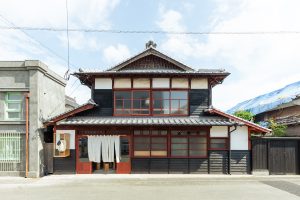
Amid this shift, Ikeda Kasuri Textile, founded in 1919, has continued for five generations to produce Kurume kasuri using natural indigo made from sukumo. One might assume this means rigidly preserving old methods, but in fact, the workshop’s approach is remarkably flexible. Without such adaptability, it would not have survived while maintaining its commitment to indigo dyeing through changing times.
“Indigo” itself encompasses many varieties worldwide. Indian indigo comes from the Indigofera genus in the legume family, while Ryukyu indigo from Okinawa belongs to the Strobilanthes genus. These are typically preserved as mud indigo. In contrast, the tade-ai used in Japan requires a process called aizome building (ai-date), in which fermented sukumo is reduced in an alkaline solution to return it to a water-soluble dye. The process is highly delicate: sugar must be added as nutrients for the bacteria, temperature must be carefully controlled, and the dye vat must be monitored, stirred, and rested according to its condition. Indigo, in this sense, is almost a living organism.
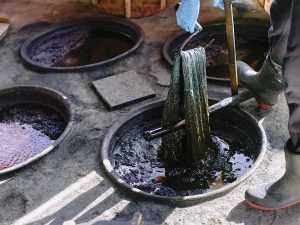
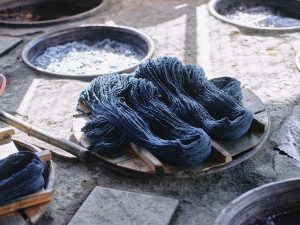
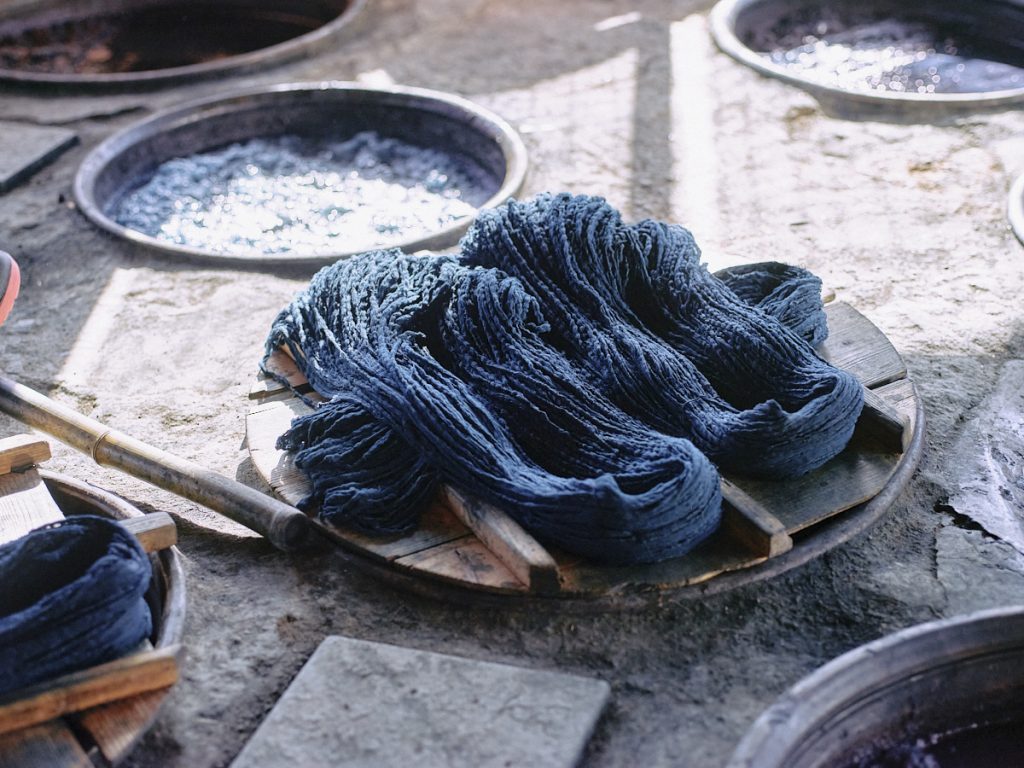
At Ikeda Kasuri Textile, there are around 20 indigo vats—the largest scale in the Kurume kasuri region. Dyeing is carried out sequentially while carefully monitoring the condition of each vat. Indigo only develops its color when exposed to oxygen. In Kurume kasuri, yarn is not only dipped into the dye but also repeatedly struck against a recessed floor to loosen the bound threads and expose them to air. This physically demanding process must be repeated dozens of times to achieve a deep indigo color. To maintain both quality and volume, the workshop uses caustic soda as the alkaline solution for indigo reduction, and handles not only its own yarn but also dyeing for other local weavers, as well as garments and accessories.

Another defining feature of Ikeda Kasuri Textile is its large-scale handweaving system—also the largest in the region. Traditionally, Kurume kasuri relied on a system called dashibata, in which home-based weavers worked on handlooms. However, as artisans have aged and lifestyles have changed, the number of weavers has declined. In response, the workshop established an in-house weaving space where artisans can come and work flexibly, weaving as much as they wish and being paid based on output.
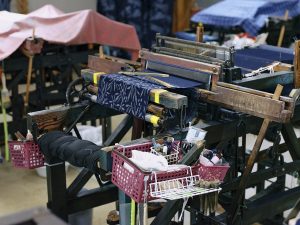
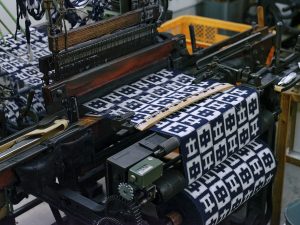
Two types of looms are used in handweaving: foot-operated looms, where the shuttle is moved by pedals, and hand-thrown shuttle looms, where all operations are done manually. Ikeda Kasuri Textile mainly uses the more efficient foot-operated looms, selecting the appropriate type depending on the pattern and the weaver. Although the workshop once transitioned to power looms during its long history, it returned to handweaving-centered production about 50 years ago.
Underlying this approach is a consistent belief: to continue producing substantial quantities of indigo-dyed, handwoven textiles. As the number of handweaving workshops declines year by year, Ikeda Kasuri Textile seeks to ensure that the origin of Kurume kasuri—indigo-dyed, handwoven fabric—does not become a relic of the past. Without being bound too rigidly by tradition, it continues to move forward, searching for the most appropriate form of production in the present age.
Opening the Value of Handweaving to Society
While preserving the traditional techniques of indigo dyeing and hand weaving, we believe it is important not to confine them to one-of-a-kind pieces, but to circulate them within society. Through division of labor and thoughtful systems, we aim to produce volume while maintaining the quality of handcraft, bringing the appeal of handwoven textiles to a wider audience. To carry tradition into the future, we continue to explore new possibilities by moving between handwork and contemporary modes of production.